Bid Volume vs Ask Volume
"Bid volume" and "ask volume" are the building blocks of almost every order flow tool. They sound simple, yet they are among the most misunderstood terms in trading.
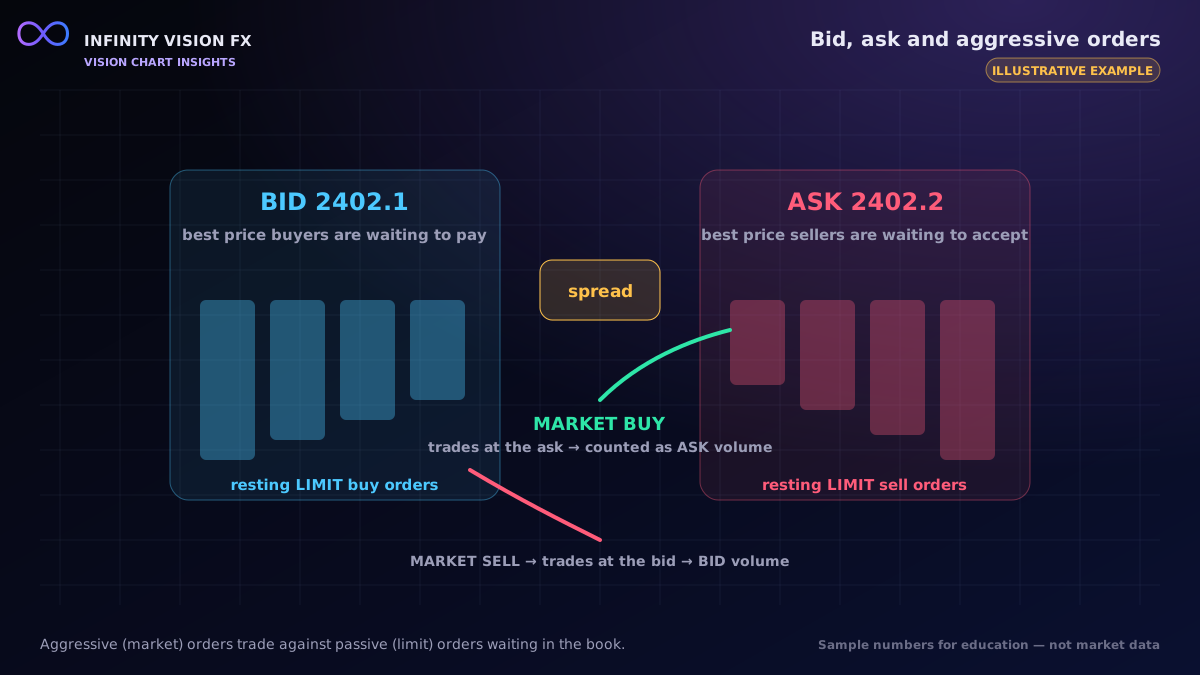
The bid, the ask and the spread
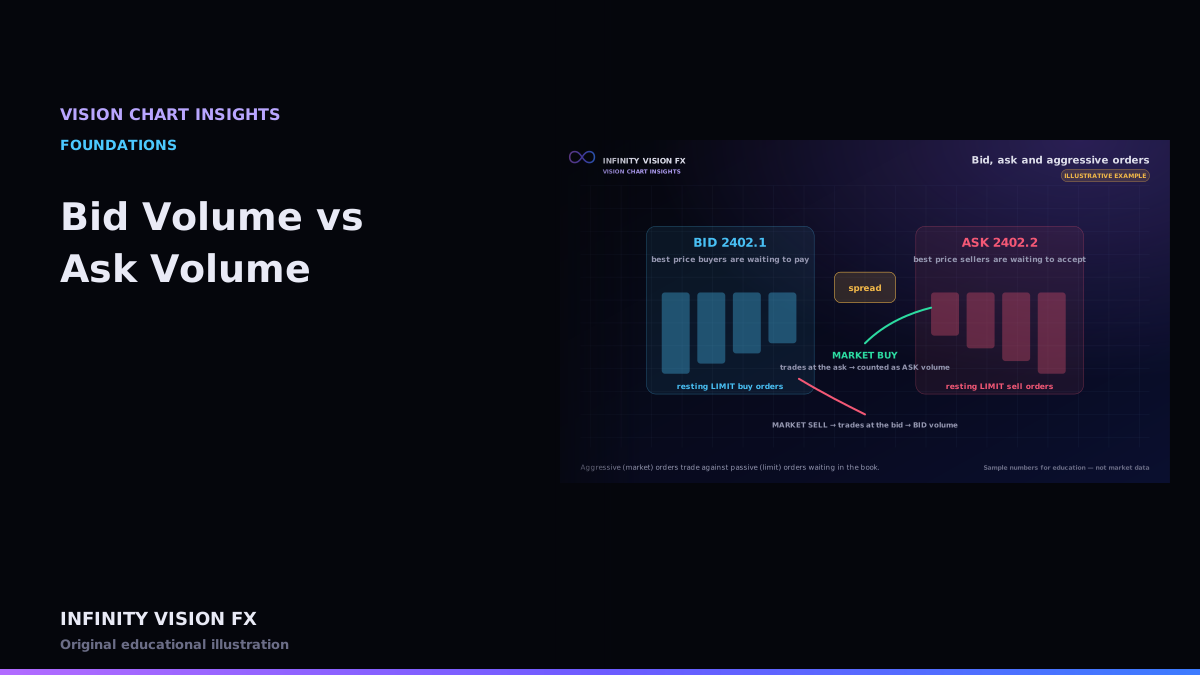
- The bid is the highest price someone is currently willing to pay.
- The ask (or offer) is the lowest price someone is currently willing to accept.
- The spread is the gap between them. In active gold futures it is often a single tick of 0.10.
How a trade gets its label
When an aggressive buyer sends a market order, it trades against the resting sell orders at the ask. That trade's volume is counted as ask volume (buy-aggressor volume). When an aggressive seller sends a market order, it trades against resting buy orders at the bid: bid volume (sell-aggressor volume).
Interactive example: open this article on the Infinity Vision FX website to use it.
A worked example (illustrative)
Suppose the market shows bid 2402.1 and ask 2402.2.
- A trader sends a market buy for 5 contracts. It fills at 2402.2 → 5 ask volume.
- Another trader sends a market sell for 3 contracts. It fills at 2402.1 → 3 bid volume.
- Delta for these two trades = 5 − 3 = +2.
What it does not mean
Every contract traded has exactly one buyer and one seller. Bid and ask volume do not tell you there were "more buyers than sellers"; they tell you which side was willing to cross the spread — usually the side with more urgency.
When the side is unknown
Some data feeds report each trade's aggressor side directly. Others do not, so software applies rules such as:
- Quote rule — trade at or above the ask = buy; at or below the bid = sell.
- Tick rule — trade above the previous price = buy; below = sell.
Both rules make mistakes, especially in fast markets. VISION CHART always labels estimated values.
Key takeaways
- Bid volume = aggressive selling; ask volume = aggressive buying.
- Volume is never "more buyers than sellers" — each trade has both.
- Aggressor side is best taken from the exchange feed; estimates must be labelled.
Next article: Understanding Market Delta
Educational content only, not financial advice. Examples and illustrations use sample numbers and are not observations of real market activity. Order flow describes past and present activity; it does not predict prices.